
Why Most Amazon Sellers Misunderstand Pricing
Most Amazon sellers think pricing works like this.
Higher price equals fewer sales.
Lower price equals more sales.
Simple.
Predictable.
Linear.
Except it is not.
On Amazon, price and sales rarely follow a clean downward sloping curve. They behave more like a messy system shaped by competitors, reviews, ranking, delivery speed, and buyer psychology.
The problem is not that sellers ignore pricing.
The problem is that they oversimplify it.
The Linear Pricing Myth
In theory, price and demand follow a smooth curve.
Raise price and volume falls.
Lower price and volume rises.
That is the mental model most people carry.
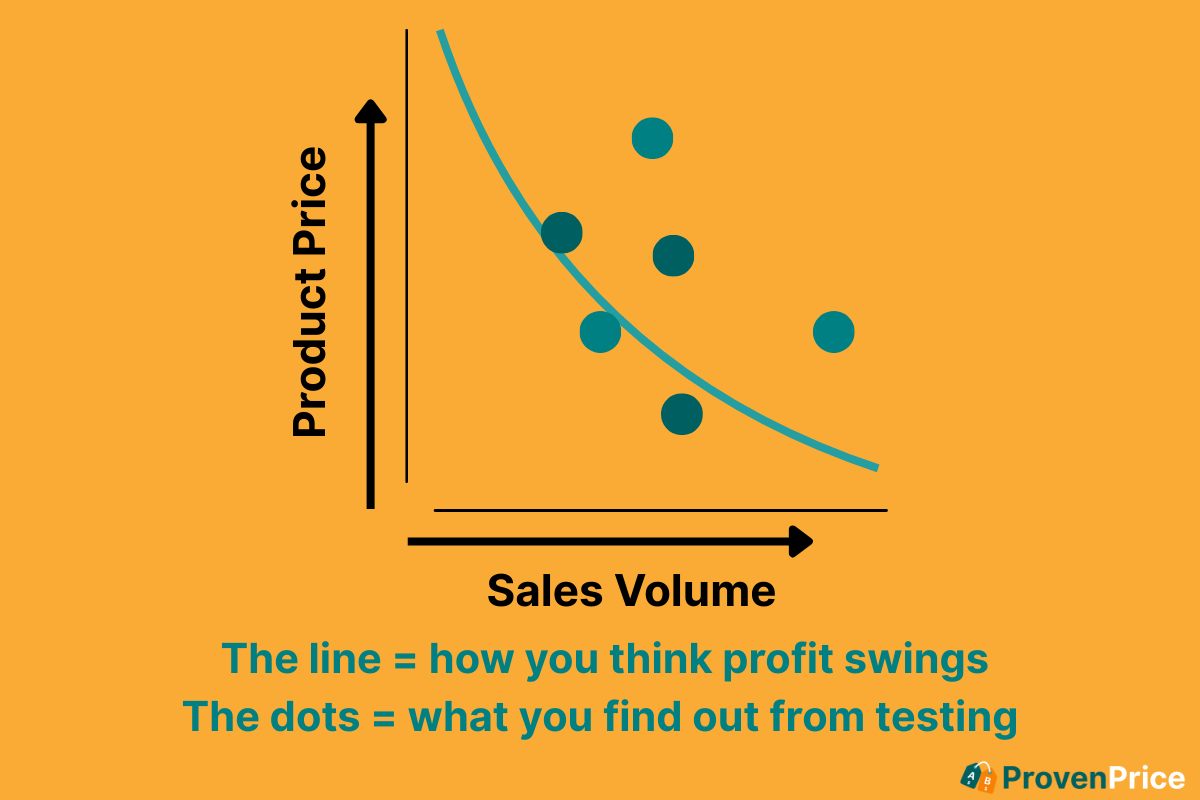
But real marketplace behavior does not look like a smooth line.
It looks like scattered dots.
Sometimes you raise price and sales barely move.
Sometimes they drop sharply.
Sometimes they go up because perceived value increases.
That is the difference between economic theory and marketplace reality.
Why Amazon Makes Pricing Even Messier
Amazon is not a traditional retail shelf.
It is a dynamic ecosystem where:
-
Competitor pricing changes daily
-
Reviews accumulate over time
-
Delivery speeds shift by ZIP code
-
Algorithms adjust ranking based on behavior
-
Advertising efficiency fluctuates
Each of these variables interacts with price.
That means a two dollar increase does not produce a predictable outcome.
A ten percent reduction does not guarantee a spike in sales.
And sometimes a change does nothing at all.
Pricing on Amazon is not linear.
It is contextual.
The Illusion of Predictability
Many sellers assume they can reason their way to the perfect price.
They look at competitors.
They calculate margin.
They make a small adjustment.
Then they wait.
When results move unexpectedly, they are surprised.
But surprise is not the exception in pricing.
It is the rule.
For example:
A two dollar price increase might raise profit twenty percent even if units drop slightly.
A ten percent price decrease might increase volume forty percent but reduce overall profit.
Or either move might have minimal impact because your product is relatively inelastic at that stage of its lifecycle.
Without data, pricing becomes storytelling.
With data, it becomes measurement.
What Most Sellers Miss About Elasticity
Price elasticity simply measures how much sales change when price changes.
Some products are elastic. Small price changes create large shifts in sales.
Some products are inelastic. Price changes barely move demand.
The critical point is this.
Elasticity is not fixed.
As your reviews grow, ranking improves, and brand trust increases, your product often becomes more inelastic.
That means the price that was optimal six months ago may not be optimal today.
Most Amazon sellers assume their pricing power is static.
Smart Amazon brands recognize that it evolves.
The Line Versus the Dots
In your head, pricing looks like a line.
Clean. Predictable. Logical.
In reality, pricing looks like dots.
Messy. Nonlinear. Context driven.
The line represents expectation.
The dots represent data.
You cannot predict every dot in advance.
You can only form a theory and measure what actually happens.
That shift in thinking changes everything.
From Assumption to Experimentation
If pricing is messy and contextual, then guessing is not a strategy.
Reacting emotionally to one slow week is not a strategy.
Copying a competitor is not a strategy.
The only sustainable approach is structured experimentation.
Form a theory about how price might impact demand.
Test it in a controlled way.
Then take action based on measured profit impact.
This is how pricing becomes a growth lever instead of a stress trigger.
Final Thoughts
Most Amazon sellers do not fail at pricing because they lack intelligence.
They fail because they rely on an overly simple mental model.
Higher price does not always mean fewer sales.
Lower price does not always mean more profit.
The marketplace is more complex than that.
The brands that win on Amazon do not rely on the line.
They study the dots.
ProvenPrice is a dedicated Amazon price testing platform that helps Amazon brands move beyond assumptions, run structured experiments, and discover how price truly affects profit and performance.