
Overlooked Amazon Pricing Opportunities Most Brands Ignore
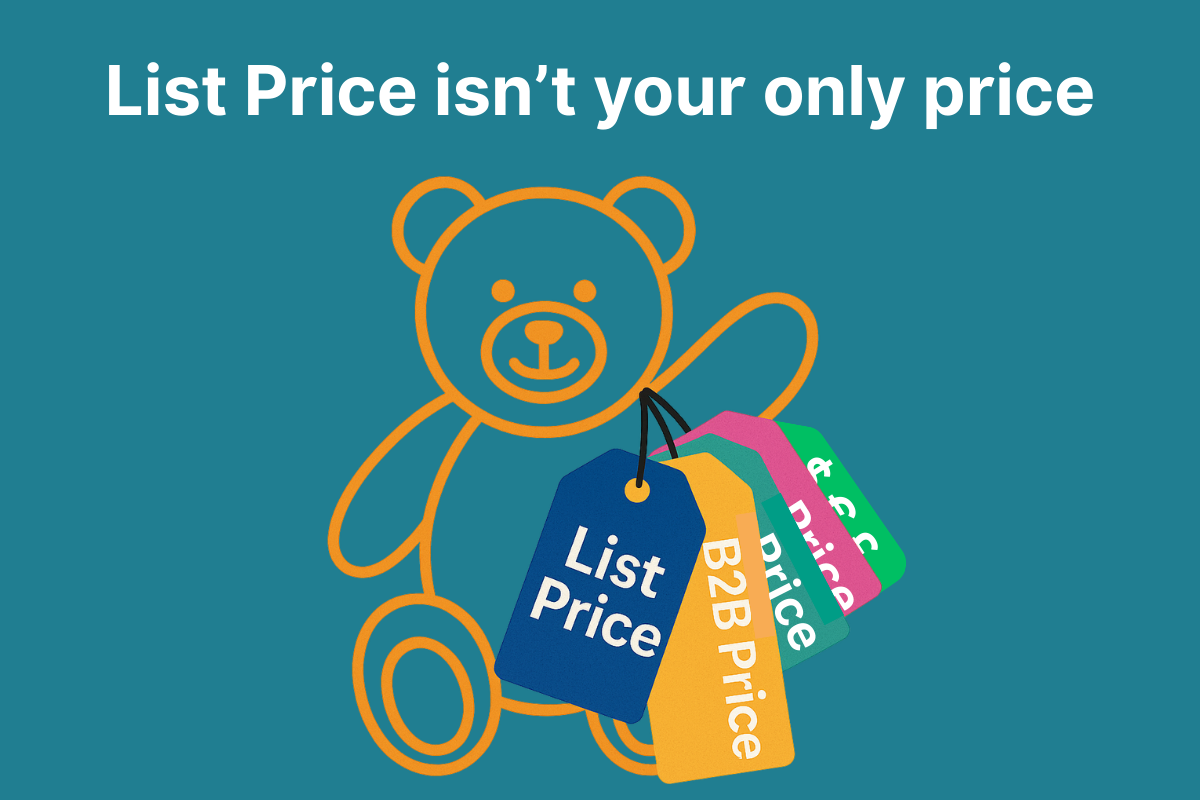
Most Amazon sellers think of price as one number.
Your list price (or your featured offer price, which is just the price in your buybox).
But Amazon gives you multiple pricing layers that influence visibility, conversion, and lifetime value.
If you only optimize your standard retail price, you are ignoring high leverage profit opportunities.
Here are four Amazon pricing levers that most brands underutilize.
1. B2B Business Pricing
If you sell in categories where business buyers are active, Business pricing can quietly drive incremental volume without disrupting your consumer positioning.
Amazon allows you to set a separate Business price.
This price can be slightly lower than your retail price while remaining profitable.
Even a one percent discount can improve visibility in Business search results.
Unlocking the Business Blue Savings Badge
To qualify for the Business Blue Savings badge, you must:
-
Offer at least a five percent discount off your standard price for single unit Business purchases
-
Or offer at least a three percent quantity discount at the first tier
That badge increases credibility and visibility with business buyers.
Monitor performance under:
Business Reports → Sales by Business Customer
Pay attention to Business Order Percentage.
Small adjustments to Business pricing can move meaningful volume, often without impacting your consumer conversion rate.
For brands in office, industrial, janitorial, food service, and consumables categories, this is often one of the most overlooked levers.
2. Subscribe and Save Pricing Strategy
Subscribe and Save is not just a discount.
It is a lifetime value engine.
Many brands set a five percent base discount and never revisit it.
But testing the difference between five percent and ten percent can materially change subscription enrollment.
Amazon has stated that on average, products discounted at ten percent base and fifteen percent tier can drive up to a 1.8 times increase in conversion.
That does not automatically mean higher margin in the short term.
But if ten percent discount dramatically increases recurring orders, the lifetime value equation changes.
The question becomes:
Is a lower first order margin worth higher subscription retention and predictable revenue?
For consumables and replenishable products, this lever is often more powerful than adjusting list price alone.
3. Virtual Bundle Pricing
Virtual bundles allow you to combine ASINs without physically repackaging inventory.
Most sellers price bundles as a simple sum of the individual items.
That is rarely optimal.
A bundle priced five to ten percent below the combined total can:
-
Increase average order value
-
Improve accessory attach rate
-
Increase perceived value
-
Improve conversion for complementary SKUs
Bundles are not only about discounting.
They are about positioning.
When a buyer sees a bundled offer that feels cohesive and slightly advantageous, the perceived value often exceeds the numerical discount.
This is especially powerful for brands with accessory ecosystems.
4. Regional and Marketplace Pricing
If you sell across multiple Amazon marketplaces, identical pricing across regions can hurt conversion.
Currency conversion is not psychology aligned pricing.
For example:
A $25.99 product in the United States may auto convert to an awkward number like $477.67 MXN in Mexico.
Round it up to $499 MXN, that charm pricing feels cleaner and often converts better.
Instead of auto converted currency:
-
Adjust to charm pricing in that region
-
Align with local competitive norms
-
Consider purchasing power and category expectations
Even small adjustments can improve perceived alignment with the local market.
Global pricing should not be automated blindly.
It should be intentional.
Why These Opportunities Matter
Each of these pricing layers operates independently from your standard retail price.
That means you can increase revenue, volume, and lifetime value without disrupting your core listing price.
Most Amazon sellers treat price as a single variable.
Mature Amazon brands treat pricing as a multi dimensional system.
Each price point becomes a data point.
Each pricing layer becomes a lever.
How to Think About These Strategically
Before adjusting any of these pricing layers, consider:
-
Does this change visibility or badge eligibility
-
Does this alter perceived value
-
Does this affect lifetime customer value
-
Does this impact profit geometry
These are structural opportunities, not random tweaks.
Some adjustments may have minimal impact.
Others may unlock disproportionate gains.
The difference lies in measurement and disciplined experimentation.
Final Thoughts
Amazon does not give you just one price.
It gives you many, such as:
-
Retail price
-
Business price
-
Subscribe and Save discount
-
Bundle pricing
-
Marketplace specific pricing
If you are only optimizing one of them, you are leaving opportunity on the table.
The brands that compound profit on Amazon do not just watch competitors.
They understand every pricing layer available to them.
ProvenPrice helps Amazon brands run structured experiments across price points, measure profit impact accurately, and identify which pricing levers actually move the business forward.