
2026 Amazon Pricing Dead Zones Explained
Amazon updated its FBA fee structures for 2026.
And hidden inside those updates are pricing ranges where raising your price actually makes you less money.
These are called pricing dead zones.
If you price inside them, you may be increasing revenue while decreasing gross profit.
Most Amazon sellers never notice.
What Is an Amazon Pricing Dead Zone
A pricing dead zone is a range of prices where increasing your product’s price results in equal or lower gross profit because Amazon’s fee structure jumps at specific thresholds.
These jumps are caused by:
-
FBA fee tier changes
-
Referral fee percentage cliffs
-
Weight based fee increases
Dead zones occur when a small price increase triggers a disproportionately large fee increase.
The result is counterintuitive.
You charge more, but keep less.
How to Read the Dead Zone Ranges
If a dead zone is listed as:
$10.00–$11.78
That means:
-
$9.99 is the last price that continues to increase gross profit
-
Prices between $10.00 and $11.78 earn less or the same gross profit
-
$11.79 is the first price that nets more than $9.99
In other words, the zone between those two prices is financially inefficient.
2026 Amazon FBA Pricing Dead Zones
Below are the most relevant dead zones based on updated 2026 fee tiers.
These ranges assume stable cost of goods and no change in conversion rate.
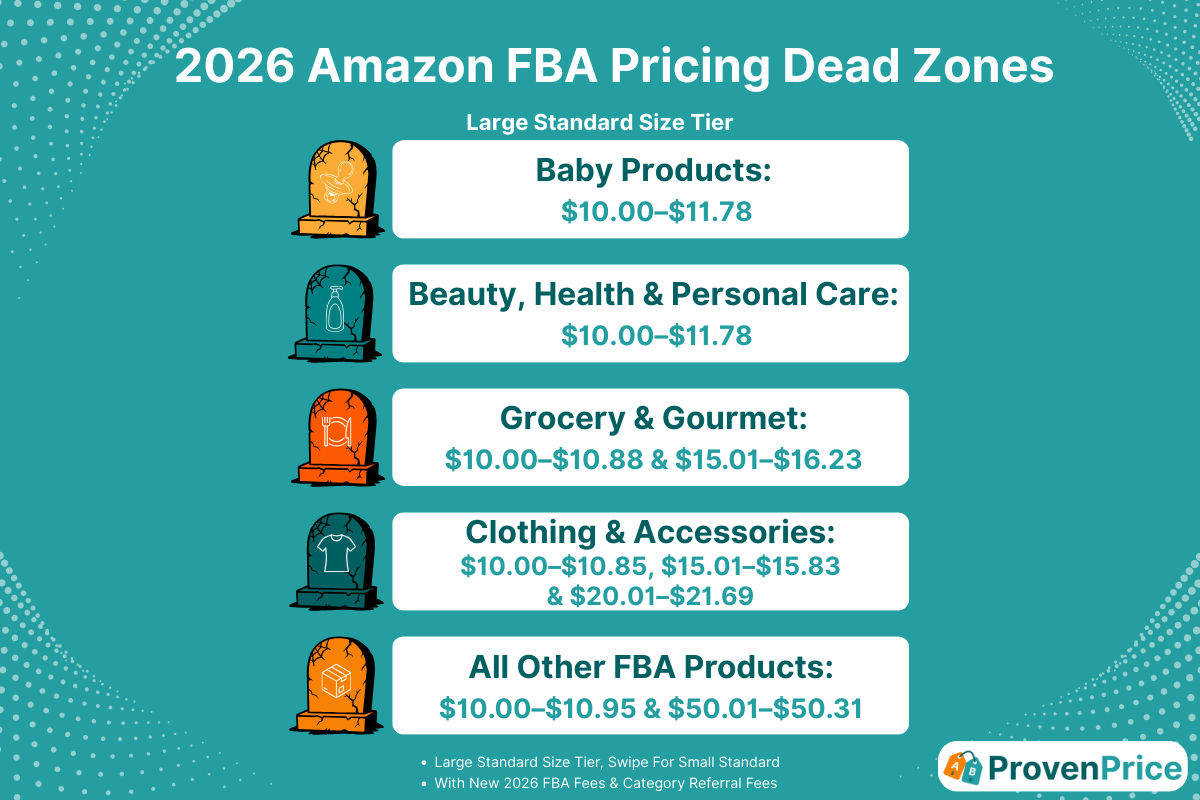
Baby Products and Beauty, Health and Personal Care
Large Standard
Referral increases from 8 percent to 15 percent combined with FBA fee jump
Dead zone: $10.00–$11.78
Small Standard
Referral increases from 8 percent to 15 percent combined with FBA fee jump
Dead zone:
$10.00–$11.85 for lighter products
$10.00–$12.00 for heavier products
These categories are especially sensitive around the $10 threshold.
Grocery and Gourmet
Large Standard
FBA jump only with 8 percent referral
Dead zone: $10.00–$10.88
Small Standard
FBA jump only with 8 percent referral
Dead zone:
$10.00–$10.95 for lighter products
$10.00–$11.09 for heavier products
All Size Tiers
Referral increase from 8 percent to 15 percent
Dead zone: $15.01–$16.23
This referral shift at $15 is one of the most overlooked cliffs in Grocery.
Clothing and Accessories
Large Standard
FBA jump only with 5 percent referral
Dead zone: $10.00–$10.85
Small Standard
FBA jump only with 5 percent referral
Dead zone:
$10.00–$10.92 for lighter products
$10.00–$11.05 for heavier products
All Size Tiers
Referral increase from 5 percent to 10 percent
Dead zone: $15.01–$15.83
Referral increase from 10 percent to 17 percent
Dead zone: $20.01–$21.69
Clothing contains multiple cliffs, making precise pricing more important than most sellers realize.
All Other FBA Products with 15 Percent Referral
Large Standard
Dead zone: $10.00–$10.95
Small Standard
Dead zone:
$10.00–$11.02 for lighter products
$10.00–$11.18 for heavier products
All Size Tiers
FBA jump at $50
Dead zone: $50.01–$50.31
Why Pricing Dead Zones Matter
Dead zones create invisible profit leaks.
Many Amazon sellers price intuitively at round numbers like:
$10.49
$10.99
$15.49
Without realizing they are inside inefficient fee bands.
A product at $10.49 will generate less gross profit than it did at $9.99.
From the outside, revenue looks higher.
But net profit is worse.
That is dangerous.
Smart Amazon brands map fee cliffs before adjusting price.
How to Avoid Dead Zones
Dead zones are mechanical.
They are not about elasticity.
They are about fee math.
Before raising your price, check:
-
Does this cross an FBA size tier boundary
-
Does this trigger a referral percentage increase
-
Does this hit a high price fee tier
If so, either:
-
Jump fully past the dead zone
-
Or remain below the cliff
Never drift into the middle.
Precision matters.
Dead Zones and Price Testing
Dead zones highlight something important.
Not all price increases are economically equal.
Some increases are structurally penalized.
Others unlock better margin dynamics.
Before running a price test, eliminate mathematically inefficient ranges.
Then test within viable zones to measure elasticity.
This is where structured experimentation becomes powerful.
You are not just testing demand.
You are testing within optimized fee geometry.
Final Thoughts
Amazon’s 2026 fee updates created new pricing dead zones across multiple categories.
Most sellers will never calculate them.
They will raise price, see revenue rise, and assume profit improved.
Often, it did not.
Understanding dead zones is not advanced finance.
It is disciplined fee awareness.
If you sell on Amazon in 2026, mapping your fee cliffs is no longer optional.
It is part of serious margin management.
ProvenPrice helps Amazon brands identify inefficient pricing ranges, run structured price experiments outside of dead zones, and measure true profit impact with clean comparisons.